
How To Install Dhcp Relay Agent In Centos 6
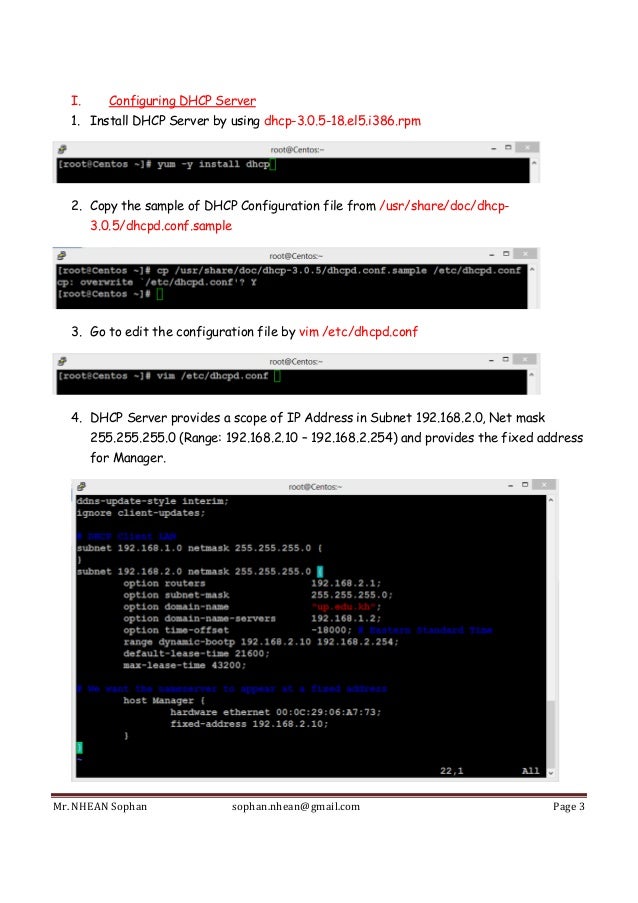
INTRODUCTION DHCP on CentOS 7/RHEL 7 In this Tutorial we are going to install DHCP (Dynamic Host Configuration Protocol). How to Install DHCP on CentOs 7 / RHEL 7. Learn how to install and configure DHCP server on CentOS. I decided not to write about this DHCP failover solution – i might someday write a post how to install DHCP in afailover solution with Corosync and Pacemaker Linux Cluster!
I've installed CentOS-6 on my server (in parallel to CentOS-5.6) and now I'm trying to set up dhcpd. I'm not sure if there has been a change in dhcpd under CentOS-6, but I'm getting the dreaded message 'Not configured to listen on any interfaces!' When I 'sudo service dhcpd restart'. I realise now that I have never known how the connection between interface (eth0 and eth1, in my case) and network (192.168.1.0 and 192.168.2.0, in my case) is established. I have DHCPDARGS=eth1 in /etc/sysconfig/dhcpd but evidently I need to say something more somewhere. Jana gana mana geetham free download.
Can one actually specify the interface in /etc/dhcpd.conf and if so how? Any suggestions or enlightenment gratefully received. Timothy Murphy e-mail: gayleard /at/ eircom.net tel: +3090, +353-1-2842366 s-mail: School of Mathematics, Trinity College, Dublin 2, Ireland CentOS mailing list.
I've installed CentOS-6 on my server (in parallel to CentOS-5.6) and now I'm trying to set up dhcpd. I'm not sure if there has been a change in dhcpd under CentOS-6, but I'm getting the dreaded message 'Not configured to listen on any interfaces!'
when I 'sudo service dhcpd restart'. I realise now that I have never known how the connection between interface (eth0 and eth1, in my case) and network (192.168.1.0 and 192.168.2.0, in my case) is established. I have DHCPDARGS=eth1 in /etc/sysconfig/dhcpd but evidently I need to say something more somewhere. Can one actually specify the interface in /etc/dhcpd.conf and if so how? Any suggestions or enlightenment gratefully received. I can not say about DHCPd in CentOS with certainty, but it should be ISC DHCP, and ISC DHCP on my routers has following syntax for subnet: subnet 192.168.219.0 netmask 255.255.255.0 range 192.168.219.170 192.168.219.199; option routers 192.168.219.100; and there is no mention of interfaces, just their IP's, and you can only set DHCP service on the first IP on the interface.
This is on my router, but should be true for all ISC DHCP servers. Ljubomir CentOS mailing list.
Timothy Murphy wrote: Ljubomir Ljubojevic wrote: and there is no mention of interfaces, just their IP's, and you can only set DHCP service on the first IP on the interface. What exactly do you mean when you say that 'you can only set DHCP service on the first IP on the interface'? I use ISC DHCP on non-CentOS router. On that router, ISC DHCP will not hand out IP addresses on second (or virtual eth0:0, eth0:1.) IP on the interface, just for the subnet original, true IP is set. Since ISC DHCP should be the same, this should be also true for CentOS version of ISC DHCP server.
 Service manuals, schematics, documentation, programs. IPPON: SMART WINNER 1500. Service manual for FISHER & PAYKEL SMART DRIVE. Electronics service manual exchange. Service manuals, schematics, documentation, programs, electronics. N ow downloading free:IPPON SMART WINNER 1500. Nvidia graphics card study extra class licence study guide ippon smart power pro 1000. 2nd edition Handpunch 1000 manual. Windows Handpunch 1000 - free. Free download Ippon Smart Winner 1000. Bb battery, smart ups 1000, ippon back verso 800, ippon smart winner 1000. Smart UPS - Service Manual free. PACKARD 8594E HEWLETT PACKARD 8594E Hp 8594e manual guide ippon smart power pro 1000 service manual. MET/CAL software supports manual. 14-day returns, A free.
Ljubomir CentOS mailing list. Timothy Murphy wrote: Ljubomir Ljubojevic wrote: and there is no mention of interfaces, just their IP's, and you can only set DHCP service on the first IP on the interface. What exactly do you mean when you say that 'you can only set DHCP service on the first IP on the interface'? I use ISC DHCP on non-CentOS router.
On that router, ISC DHCP will not hand out IP addresses on second (or virtual eth0:0, eth0:1.) IP on the interface, just for the subnet original, true IP is set. Since ISC DHCP should be the same, this should be also true for CentOS version of ISC DHCP server. Did you use a 'shared-network' declaration? It still isn't going to be able to distinguish which address range to give out to any particular client unless you've specified the hardware ethernet for it, though. Les Mikesell CentOS mailing list.
and there is no mention of interfaces, just their IP's, and you can only set DHCP service on the first IP on the interface. What exactly do you mean when you say that 'you can only set DHCP service on the first IP on the interface'? I use ISC DHCP on non-CentOS router. On that router, ISC DHCP will not hand out IP addresses on second (or virtual eth0:0, eth0:1.) IP on the interface, just for the subnet original, true IP is set. Since ISC DHCP should be the same, this should be also true for CentOS version of ISC DHCP server.
Did you use a 'shared-network' declaration? It still isn't going to be able to distinguish which address range to give out to any particular client unless you've specified the hardware ethernet for it, though. On the router I am using I guess that info is taken from the router it self. I just have to declare subnet and that is it. Routers always respond on any interface with first IP declared on that interface, and it is always with the first IP.
Giving out IP is on the same principlerequest comes on the interface and server queries first IP address of the interface and searches for the subnet. No, it isn't quite the same.
The shared-network declaration should let dhcpd match up the physical interface with one of the subnets and associate all that are grouped. But it may give out all of one range before starting on another in the group.
I've installed CentOS-6 on my server (in parallel to CentOS-5.6) and now I'm trying to set up dhcpd. I'm not sure if there has been a change in dhcpd under CentOS-6, but I'm getting the dreaded message 'Not configured to listen on any interfaces!' when I 'sudo service dhcpd restart'. I realise now that I have never known how the connection between interface (eth0 and eth1, in my case) and network (192.168.1.0 and 192.168.2.0, in my case) is established.
I have DHCPDARGS=eth1 in /etc/sysconfig/dhcpd but evidently I need to say something more somewhere. Can one actually specify the interface in /etc/dhcpd.conf and if so how? Any suggestions or enlightenment gratefully received. I read through the rest of the response but I'm thinking what I have to say fits better here than lower in the comments thread. Some things to check: RHEL6/CentOS6 likes to let NetworkMangler control interfaces even if the system is a server and running services like dhcpd.
You may be getting a failure message since the interface isn't up when dhcpd gets started. I only find NetworkMangler useful on systems that regularly change connectivity like my laptop. I just find it gets in the way on stable, wired networks. The same problem can occur on VMs just because the virtual interface comes up more slowly the a 'real' hardware device.
That is, eth1 sn't there yet when dhcpd starts. If you specify the correct interface that matches the IP address you want DHCP services on in /etc/sysconfig/dhcpd you shouldn't need a dummy interface/network specification. I notice that you mention /etc/dhcpd.conf but the location of the configuration file moved to /etc/dhcp with RHEL6/CentOS6. Unless you edit the startup files, dhcpd will use the configuration file /etc/dhcp/dhcpd.conf Cheers, Dave CentOS mailing list.